Essay
Anatomy of a Record Short Squeeze: How a Treasury Notice and a White House Name-Drop Broke Bitcoin's August Chop
By Doug Liles ·
Wednesday, August 19, 2026 was the day crypto’s slow August ended.
Bitcoin opened the UTC session at $64,718 and closed at $69,326 — a 7.1% close-to-close move, 9.1% from the day’s low to its high. In the 24 hours that followed, roughly $2.99 billion of leveraged positions were force-closed across the market, and $2.74 billion of them were shorts. That is the largest short liquidation in the records CoinGlass has kept since 2021, ahead of the $2.47 billion that was wiped on October 10, 2025. More than 172,000 traders were liquidated.
The number you have probably seen is “$1.1 billion.” That was real, but it was a mid-day snapshot of Bitcoin short liquidations alone. By the time the 24-hour window closed the event was roughly two and a half times larger.
What interests me is not the candle. It is that none of the catalysts came from inside crypto. A Treasury debt-management notice, a proposed SEC rule, and a sentence spoken in the Roosevelt Room did the work. I spend most of my time building governance and compliance systems for public agencies and AI platforms, and this was the cleanest case study I have seen of a policy calendar propagating through market structure into price inside a single trading day. If you run a treasury, a compliance function, or a company that touches on-chain rails, the mechanism matters more than the move.
Here is what happened, what the record actually supports, and what to watch next.
1. The Treasury notice that lit the fuse
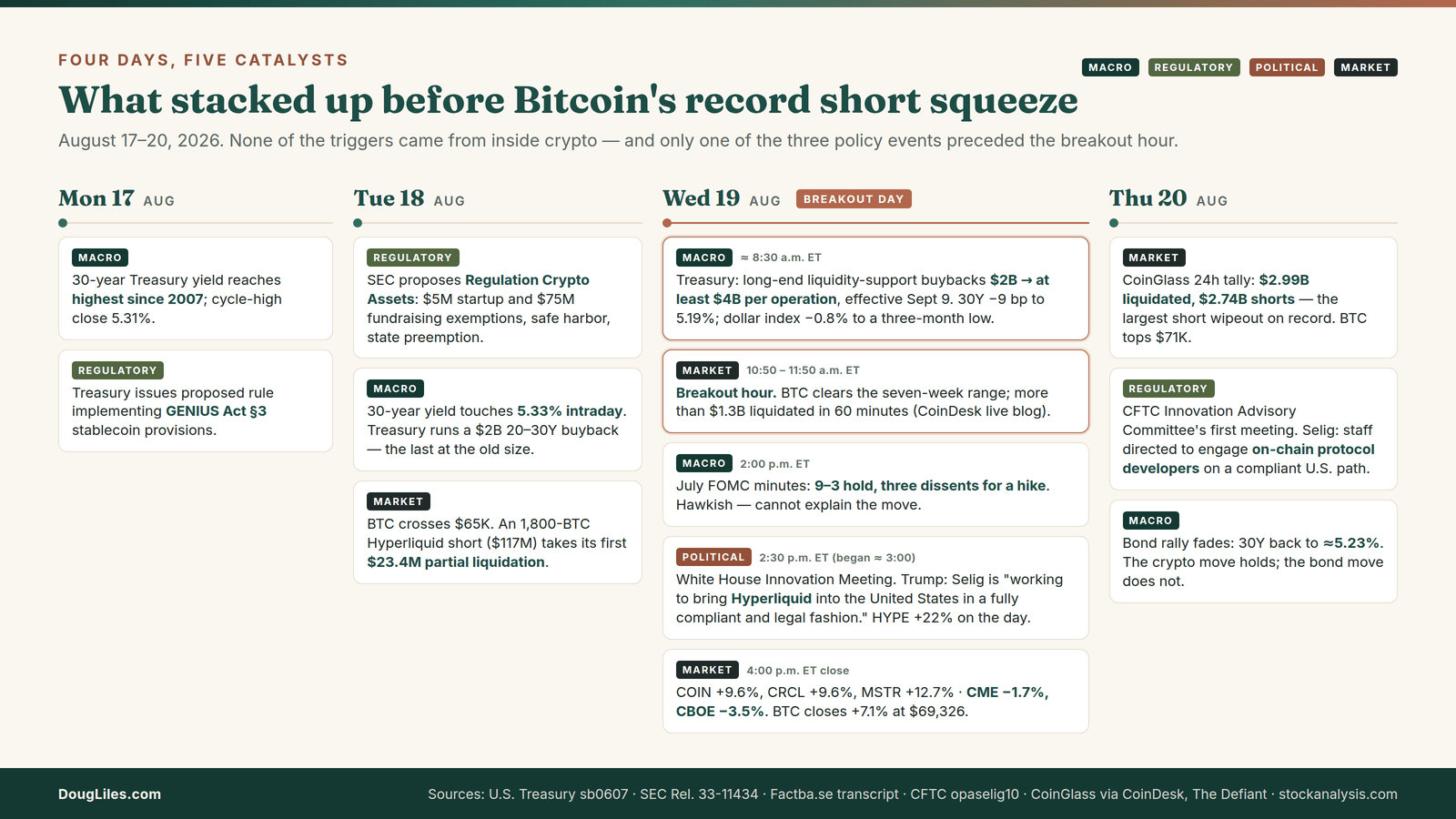
The spark did not come from the crypto market. It came from a press release out of the Treasury Department at about 8:30 a.m. ET on August 19, an hour before U.S. equities opened, titled “Treasury Announces Increased Sizes of Nominal Long-End Liquidity Support Buybacks Beginning September 9.”
The operative sentence: “The current maximum size of $2 billion per operation will be at least $4 billion per operation.” That applies to the 10-to-20-year and 20-to-30-year nominal coupon buckets, takes effect September 9, and runs through the end of the refunding quarter on November 4. It was a mid-quarter change — the quarterly refunding had been published two weeks earlier, on August 5 — which is what made it read as a response rather than a plan.
The thing it was responding to was the long end of the curve. On Tuesday, August 18, the 30-year Treasury yield touched 5.33% intraday, its highest since 2007. (The 2007 peak close was 5.35%; the October 2023 scare topped out at a 5.11% close.) The day before the notice, Treasury had run a $2 billion buyback in the 20-to-30-year bucket. The day after, it doubled the size.
The market read it as a put under long bonds. The 30-year had already dropped about 8 basis points by 9 a.m. ET and finished the day 9 lower at 5.19%. The dollar index dropped 0.8% to roughly 99, its lowest since late May. Every risk asset caught a bid, and Bitcoin — the most levered, most shorted, most 24/7 of them — caught the biggest.
Two corrections to the version going around.
First, a buyback is not a “remortgage” and it is not quantitative easing. Treasury buys back old, illiquid bonds and pays for them by issuing new ones; its own design documents say buyback amounts “will be treated like any other source of borrowing needs.” No new base money is created. TD Securities’ Gennadiy Goldberg called it “not QE” and closer to Operation Twist; his colleague Prashant Newnaha put it more bluntly: “The buyback is not QE, but the Treasury blinked.” The same 2024 document also says Treasury “does not intend to use buybacks to respond to episodes of acute market stress” — which is in some tension with doubling the long-end program the day after a 19-year high in yields. That tension is the story, not the mechanics.
Second, the bond move did not hold. By August 20 the 30-year had given back roughly half of the drop, closing near 5.23%, and Bloomberg’s assessment was that the plan was “at best a circuit breaker for the global bond slump.” The crypto move held; the bond move faded. Keep that asymmetry in mind for the “turnaround or trap” question at the end.
The sequencing matters, so here it is in one line. Treasury notice, roughly 8:30 a.m. ET. Bitcoin’s breakout hour, 10:50 to 11:50 a.m. ET, during which CoinDesk’s live blog counted more than $1.3 billion liquidated. FOMC minutes, 2:00 p.m. White House remarks, scheduled for 2:30 and starting closer to 3:00. Only one of the three policy events precedes the breakout, and it is the Treasury notice. The minutes, for what it is worth, were hawkish — a 9–3 hold with three dissents in favor of a hike — which pushes yields up, not down, and so cannot explain the move either.
2. The SEC rule the rally rode in on
The day before, August 18, the SEC announced Regulation Crypto Assets, Release No. 33-11434. It is a proposed rule, not an order or a concept release; it was published in the Federal Register on August 21 and comments are due October 20, 2026.
The structure, verified against the release:
| Provision | What it does |
|---|---|
| Startup exemption | Crypto offerings up to $5 million over a four-year period; notice filing, website disclosure, no financial statements |
| Fundraising exemption | Up to $75 million in any twelve months: Tier 1 to $20 million, Tier 2 to $75 million with audited financials; SEC qualifies a Form 1-CRYPTO offering statement |
| Safe harbor | Conditional exclusion from the “investment contract” definition once the issuer certifies that essential managerial efforts are complete |
| Preemption | Federal preemption of state registration and qualification requirements |
Chairman Paul Atkins’ statement is unusually direct about what it replaces. The Commission, he wrote, had in the past “actively undermined capital formation with regard to this asset class in the form of regulation by enforcement and disingenuous offers to ‘come in and register.’” Commissioner Mark Uyeda described the prior approach as “advancing untested legal theories through enforcement actions rather than rulemaking.” The lineage runs straight to Commissioner Hester Peirce’s 2020 Token Safe Harbor proposal, which Atkins credited by name when he previewed these tiers in March.
Two framing corrections here, because both are being repeated.
“The first crypto-specific rulemaking in the agency’s 90-year history” is a TechTimes headline, not an SEC claim. The SEC was created in 1934, so it is 92 years old, and it proposed crypto-related rules before — the 2022 exchange-definition amendments that would have swept in DeFi, and the 2023 custody proposal, both withdrawn in June 2025. What is accurate: this is the first crypto-specific offering exemption the SEC has ever put out for notice and comment, and the first major crypto rule of Atkins’ tenure.
And the pivot is not from “enforcement-only” to “functional registration.” Atkins explicitly derides the old “come in and register” offer. The pivot is to fit-for-purpose exemptions and a safe harbor. Only the $75 million tier involves the SEC qualifying anything, and that is closer to Regulation A than to a registered offering. For a founder, that distinction is the whole ballgame: the proposal is a compliant way to raise without registering, not a friendlier way to register.
3. The sentence in the Roosevelt Room
At 2:30 p.m. ET on August 19 — by which point Bitcoin had already broken out — President Trump hosted what the CFTC billed as the “White House Innovation Meeting” — a kickoff for the inaugural meeting of the CFTC’s new Innovation Advisory Committee the following day. The invitation named the Eisenhower Executive Office Building; contemporaneous reports place the remarks in the Roosevelt Room. Attendees included Treasury Secretary Bessent, Commerce Secretary Lutnick, SEC Chairman Atkins, CFTC Chairman Michael Selig, David Sacks, and executives from Coinbase, Kraken, Robinhood, Ripple, Nasdaq, ICE, Gemini, Chainlink and a16z.
The remark that moved markets, from the transcript:
“In May, Chairman Selig authorized the first ever true Bitcoin perpetual futures contract on a CFTC-registered exchange. … I understand that Mike is also working to bring Hyperliquid into the United States in a fully compliant and legal fashion. He’s working very hard on that.”
Hyperliquid is a decentralized perpetuals exchange whose front end geoblocks U.S. persons; its terms classify Americans as restricted users even though the protocol itself is permissionless. A president naming an off-limits venue as something his regulator is working to onshore is a new kind of signal, and the market treated it that way. HYPE, the exchange’s token, finished the day up about 22%. Hyperliquid Strategies, a listed treasury vehicle, closed up 30%, a record single-day gain.
Now the reality check, because the draft I started from overstated this.
There is no “Selig Framework.” Nobody at the CFTC uses that term, and I could not find it in any agency document. What exists is a series of signals, all on the record, that add up to a direction:
On March 3 at Milken, Selig said the prior administration had treated “many of these … types of software systems as a type of exchange or broker,” and that “to the extent that an on-chain software system or frontend does implicate our rules and regulations we’re modernizing and future proofing those rules so that there’s a place for all of that.” On March 10 at FIA Boca: “For too long, there has been an open question as to whether software providers trigger the CFTC’s registration requirements. We intend to address this question head-on.” On March 17, CFTC staff issued Letter No. 26-09, a no-action letter allowing Phantom’s non-custodial wallet to route orders to CFTC-registered exchanges without registering as an introducing broker — limited to regulated venues, not DeFi. On May 29 the agency approved Kalshi’s BTCPERP, the first perpetual on a registered U.S. exchange, alongside a policy statement on listing perpetual contracts. And on August 20, at the Innovation Advisory Committee, Selig said he had “directed staff to engage with developers of onchain finance protocols to establish ways in which developers can offer their protocols in a legal and compliant manner in the United States.”
The “license the front door, not the matching engine” idea is real, but it is the industry’s ask, not yet the agency’s rule. It comes from the Hyperliquid Policy Center, launched February 18, 2026 with Jake Chervinsky — formerly chief legal officer at Variant and before that at the Blockchain Association — as CEO and funded with one million HYPE from the Hyper Foundation. On July 9, HPC and Phantom co-signed a comment letter to the CFTC’s fintech request for information with three asks: on-chain software alone should not trigger exchange or clearinghouse registration; non-custodial front ends should not be introducing brokers; and Letter 26-09 should be codified. (Phantom is a co-signatory, not part of HPC.) Selig has signaled sympathy with all three. He has not published a rule on any of them.
And the incumbents are not waiting politely. CME Group sued the CFTC in July over its perpetuals approach, with CEO Terry Duffy asking, in effect, what the agency was doing to police U.S. participation in something that is illegal for them to do. Trump’s remark did not resolve that. As CoinDesk put it the same evening, the comment “doesn’t mean the CFTC has approved the exchange.”
4. The market voted on venue, not just on price
The equity tape on August 19 is the most useful single chart from the day, because it shows what the market thinks the policy means rather than just that it likes it.
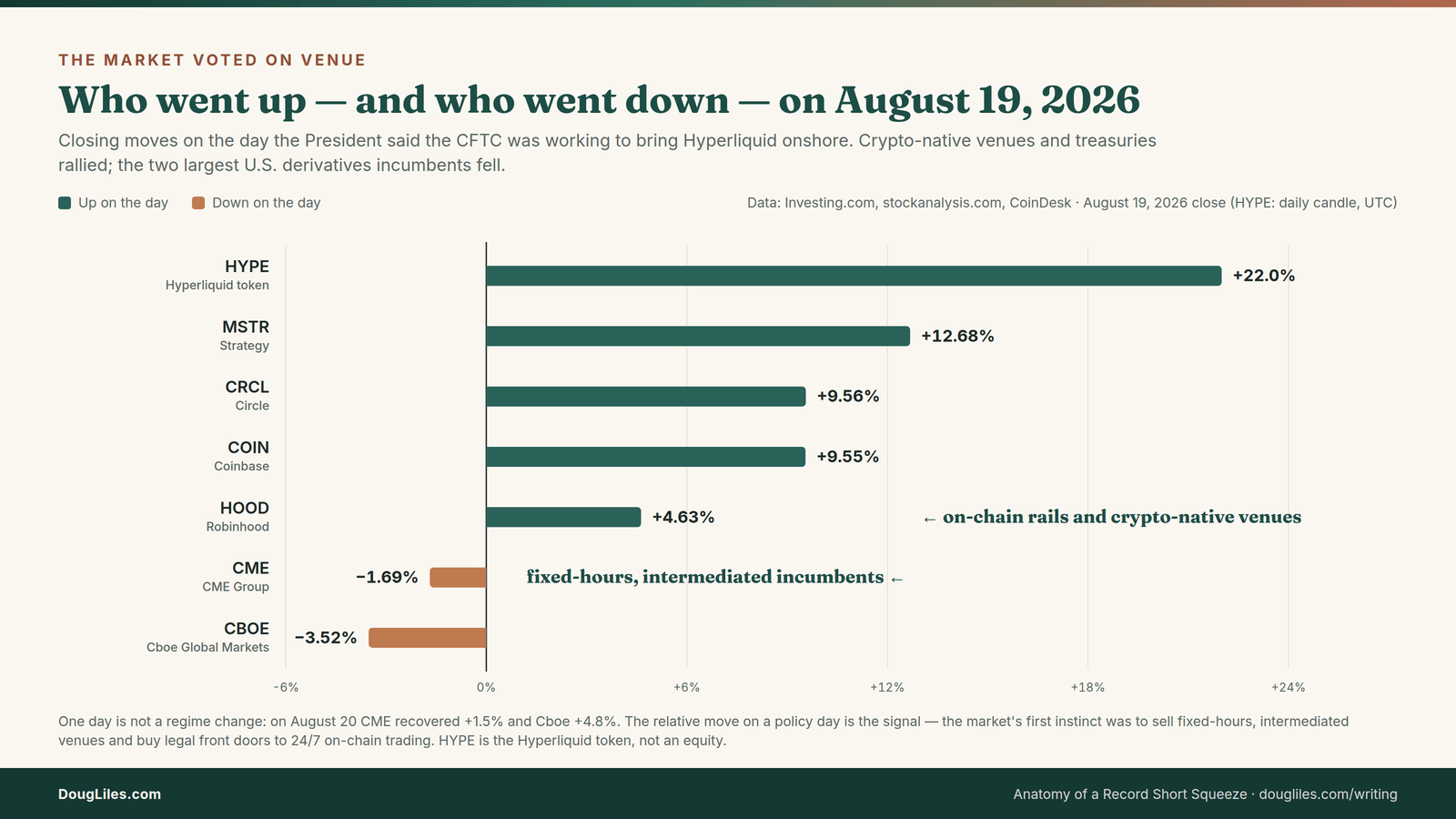
Coinbase closed up 9.55%. Circle up 9.56%. Strategy up 12.68%. Robinhood up 4.63%. CME Group closed down 1.69% and Cboe down 3.52% — on a day the broader risk complex rallied.
Be careful with the word “flippening.” One day’s tape is not a regime change, and the next day CME rose 1.47% and Cboe 4.76%, recovering the damage. But the relative move on a policy day is information. When the President says the CFTC is working to onshore a 24/7, cross-margined, on-chain perpetuals venue, the market’s first instinct was to sell the two largest U.S. exchanges that run fixed hours through layers of intermediaries, and to buy the firms positioned as legal front doors to on-chain trading. CME’s lawsuit against its own regulator is the incumbent’s answer to that instinct. Call this one inferred, not verified: the direction of the tape is a fact; the reason is a reading.
5. Where the shorts went to die
The most pointed irony of the day is that the venue the President named as a future compliant U.S. market is where the biggest bears were liquidated, in public, in real time.
On August 18, as Bitcoin crossed $65,000, a wallet beginning 0x8c96 holding an 1,800 BTC short — about $117 million notional — on Hyperliquid took its first partial liquidation: 360 BTC, roughly $23.4 million. A second partial followed on the 19th, and by the end of that session the entire position was gone. The largest single liquidation of the day, per CoinGlass, was a roughly $48.8 million BTC-USD position, also on Hyperliquid. (The “$48.4 million” figure in circulation is a transcription error.) The next morning a 50,000 ETH short, about $106 million, belonging to a trader who had made $49 million shorting crypto, was liquidated in twelve seconds for a $24 million loss.
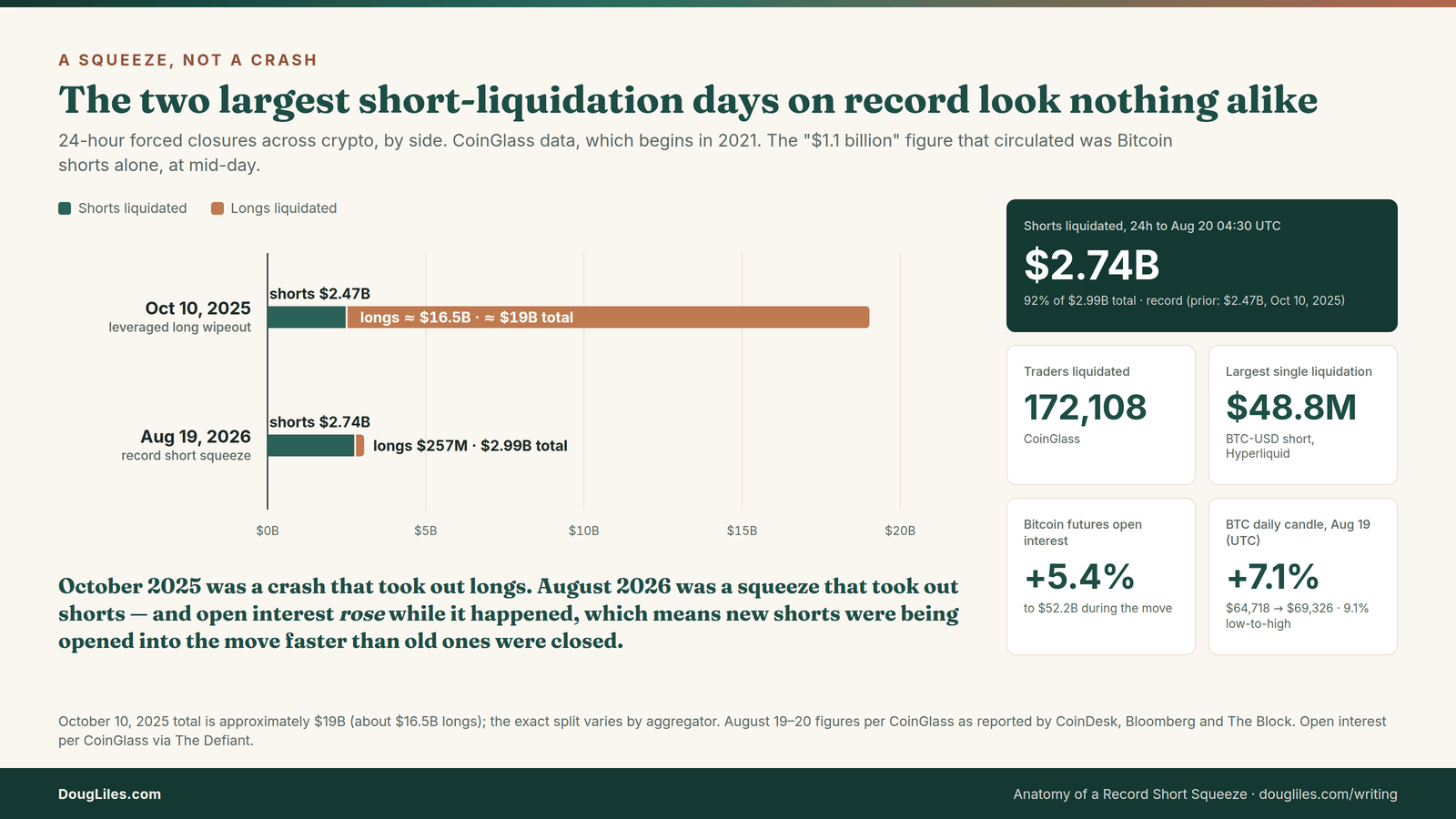
The detail that tells you what kind of move this was: Bitcoin futures open interest rose 5.4% to $52.2 billion during the rally, per CoinGlass data cited by The Defiant. When shorts are merely covering, open interest falls — closed positions leave the book. When open interest rises into a squeeze, new shorts are being opened faster than old ones are being force-closed. Traders were stepping in front of the move to short the top, and the move ran over them in sequence. That is fuel, and it is also the reason a squeeze like this one does not resolve in an hour.
It is also a small, concrete illustration of something I care about more than Bitcoin: the on-chain venue was the one where every liquidation was visible on a block explorer, wallet by wallet, as it happened. The offshore centralized exchanges publish aggregates; Hyperliquid published the ledger. Whatever the CFTC eventually decides about front ends, the auditability asymmetry is real and it runs the opposite direction from the one most regulators assume.
What the draft got wrong — and what the record says
I started from a version of this story that was circulating within hours of the move. Most of it held up. Here is what did not, because the corrections are useful on their own.
| Circulating claim | What the record supports |
|---|---|
| “$1.1 billion liquidation, the largest short liquidation on record” | $1.1B was BTC shorts at mid-day. Full 24h: $2.99B total, $2.74B shorts (92%) — the record. Prior record $2.47B shorts, Oct 10, 2025. |
| “9% daily God candle” | 9.1% low-to-high; 7.1% close-to-close ($64,718 → $69,326). |
| “The Treasury doubled buybacks” | Correct, but effective September 9, not immediately; long-end buckets only; a mid-quarter change. |
| “Meeting at the Eisenhower Executive Office Building” | Billed for the EEOB; remarks delivered in the Roosevelt Room per contemporaneous reports. |
| “Trump name-dropped ‘hyperlid’” | Transcript reads “hyper liquid”; the reference is unambiguous. Quote otherwise accurate. |
| “The Selig Framework” | Not a term the CFTC uses. A sequence of on-record signals plus an industry comment letter. |
| “Hyperliquid Policy Center … in collaboration with Phantom” | HPC launched Feb 18, 2026, Chervinsky as CEO. Phantom co-signed one letter (July 9); it is not part of HPC. |
| “First crypto-specific rulemaking in the SEC’s 90-year history” | A TechTimes headline. SEC is 92; earlier crypto proposals existed and were withdrawn. Accurate: first crypto-specific offering exemption ever proposed. |
| “Pivot from enforcement-only to functional registration” | Pivot is to exemptions and a safe harbor; Atkins explicitly disowns “come in and register.” |
| “Senate closure vote September 15” | Cloture vote on the motion to proceed to H.R. 3633, 2:15 p.m. ET, Tuesday Sept 15. Not a passage vote. |
| “$48.4 million short liquidation” | $48.8 million per CoinGlass. The $23.3M event was Aug 18, a partial on an 1,800 BTC short. |
| “OI rose 5.4% to $52 billion” | Correct: Bitcoin futures OI, $52.2B (CoinGlass via The Defiant). |
Turnaround or trap?
Both readings are defensible, which is why the question is worth asking precisely.
The trap reading: open interest rose into the move, which means the squeeze was manufactured by the people betting against it. The bond rally that triggered it reversed within a day. Jackson Hole is next week, and a Fed that has just been publicly leaned on by the Treasury has reasons to sound hawkish. Crowded-short flushes in August have a long history of giving way to September chop.
The turnaround reading: unlike most squeezes, this one has a dated policy calendar underneath it. The buybacks start September 9 and run through November 4. The SEC’s comment period runs to October 20. The Senate votes September 15. Each is a scheduled event that either confirms or falsifies the thesis, and that is a different kind of floor than “sentiment.”
My own read is that the calendar decides it. There are five dated tests between now and the end of the refunding quarter, and three of them land in the next four weeks.
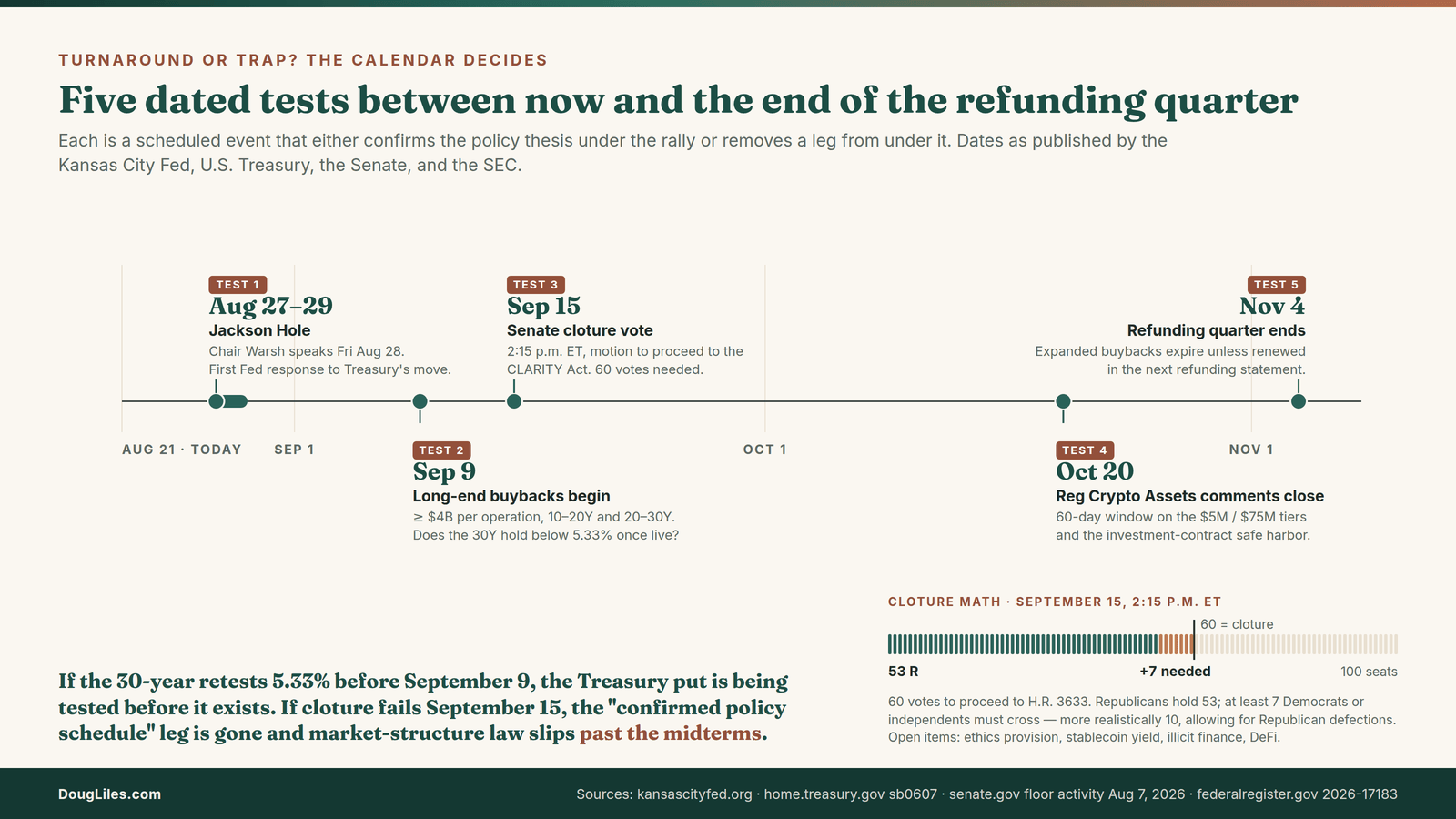
Test 1 — August 27–29, Jackson Hole. Chair Kevin Warsh speaks Friday, August 28. The Treasury’s move has been widely framed as pressure on the Fed. If Warsh pushes back, the long end can retest 5.33% before the buybacks even start, and the “put” gets tested before it is in place.
Test 2 — September 9, the buybacks begin. At least $4 billion per operation in the 10-to-20 and 20-to-30-year buckets. The question is simple: does the 30-year hold below its August 18 high once the operations are live? If it does not, the Treasury has spent a tool and the macro leg of this rally is gone.
Test 3 — September 15, 2:15 p.m. ET, the cloture vote. Sixty votes to proceed to H.R. 3633. Republicans have 53, so at least seven Democrats or independents have to cross, and more realistically ten, given likely Republican defections. Senator Gallego, one of two Democrats who voted the Banking Committee’s text out in May, said on August 19: “Don’t go for a fast vote. A fast vote gets you a fast result, but I’m not sure it’s the result you want.” The unresolved items are the government-ethics provision, stablecoin yield, illicit-finance rules, and how DeFi is treated. A failed cloture vote does not kill the bill, but it takes the “confirmed policy schedule” leg out from under the rally and pushes market-structure legislation past the midterms.
What to do with this
If you build or advise companies that issue tokens: read the proposing release and decide whether the $5 million startup tier or the $20 million Tier 1 fits a U.S.-organized issuer you know, then file a comment by October 20. The SEC is explicitly soliciting views on the thresholds, and the thresholds are the product.
If you sit anywhere near public finance: note that a one-page Treasury debt-management notice moved risk assets more than the FOMC minutes released that afternoon. Debt-management operations are now a policy lever in their own right, and they will be read as one. That changes how you should read the quarterly refunding documents.
If you carry leverage in any market: open interest rising into a rally is the tell. It meant new shorts were being opened into the move, not closed, and it meant the squeeze had fuel left. Watching the liquidation heatmaps after the fact is entertainment; watching open interest and funding during the move is information.
And if you are in the room when on-chain market structure gets written — the CFTC’s advisory committee, the Senate staff working the DeFi title, the state regulators who just got preempted on paper — the Hyperliquid episode is your case study in both directions. The venue Americans cannot legally use was the one where every forced closure was publicly auditable. Any rule that onshores it should keep that property, not trade it away for a familiar-looking intermediary.
This is analysis of public events, not investment advice. Figures are as reported by the primary sources linked above as of August 21, 2026; market data from CoinGlass, Investing.com and stockanalysis.com; yields from the Treasury’s daily par yield curve.
Sources
- U.S. Treasury, “Treasury Announces Increased Sizes of Nominal Long-End Liquidity Support Buybacks Beginning September 9”, August 19, 2026; Q3 2026 tentative buyback schedule; buyback design supplement, 2024; daily par yield curve, August 2026.
- SEC, press release 2026-76; Atkins statement; proposing release 33-11434; Federal Register notice, August 21, 2026.
- White House remarks, August 19, 2026: video; Factba.se transcript.
- CFTC: Selig remarks at the White House Innovation Meeting; Selig remarks to the Innovation Advisory Committee, August 20, 2026; Staff Letter 26-09; Release 9240-26, perpetual contracts.
- Senate: floor activity, August 7, 2026; The Block, “Thune files cloture on Clarity Act, setting up Sept. 15 Senate vote”.
- Liquidation and market data: CoinDesk, “Bearish crypto bets lose record $2.7 billion”; Bloomberg, “Crypto Surge Triggers Record $2.7 Billion of Short Liquidations”; The Defiant, “Bitcoin tops $68K as short liquidations hit $1.7 billion”; CoinDesk, “Trader who made $49 million shorting crypto lost $24 million on ether in 12 seconds”.
- Hyperliquid and policy: CoinDesk, “HYPE jumps as Trump says CFTC is working to bring Hyperliquid to U.S.”; The Block, “Hyperliquid Policy Center, Phantom urge CFTC…”; Bankless, “Jake Chervinsky launches Hyperliquid Policy Center”; CoinDesk, “Inside the CME and CFTC’s battle over onchain perpetual futures”.
- Macro context: Axios, “Bessent’s Treasury buyback plan”; Reuters via Yahoo Finance, “Dollar hugs three-month lows”; Kansas City Fed, Jackson Hole 2026.
Related: the ecosystem ·AI for Good podcast ·work with me.